When will Tibo press the button again?
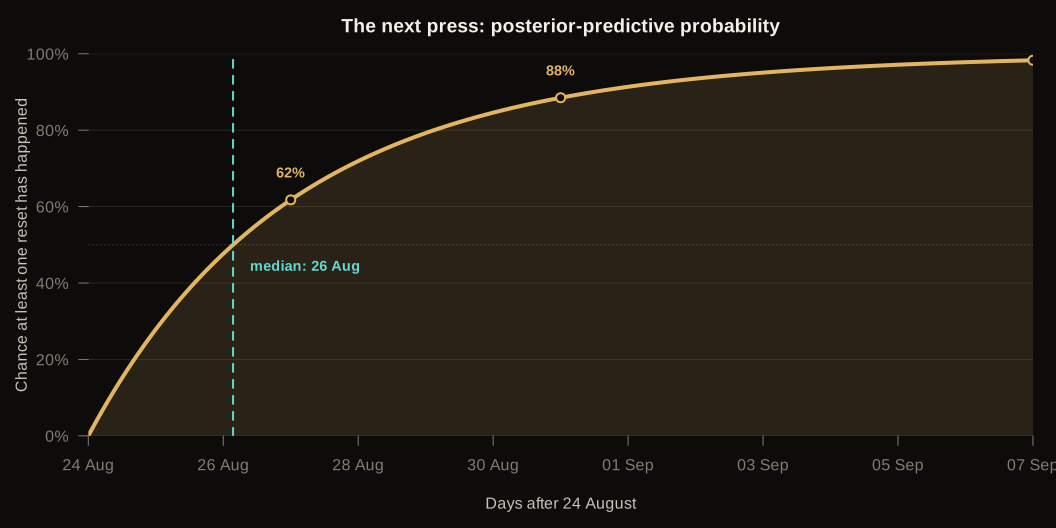
Tibo Sottiaux announced 24 broad Codex and ChatGPT Work usage resets in 100 days. We collected every one, then made R predict the next. The model says Wednesday afternoon.
Wednesday, 26 August.
About 4:49pm Sydney time.
That is the posterior median—not an appointment in Tibo’s calendar. The model assigns a 50% chance to a reset before then and 50% after.
chance of another broad reset within three days
The trailing 50 days contained 16 reset announcements. A Bayesian Poisson event model turns that cadence into a waiting-time forecast.
The reset button became a product surface.
Early resets mostly compensated for incidents. By July they were also launch mechanics, milestone celebrations and a way to absorb rough edges while millions of users arrived.
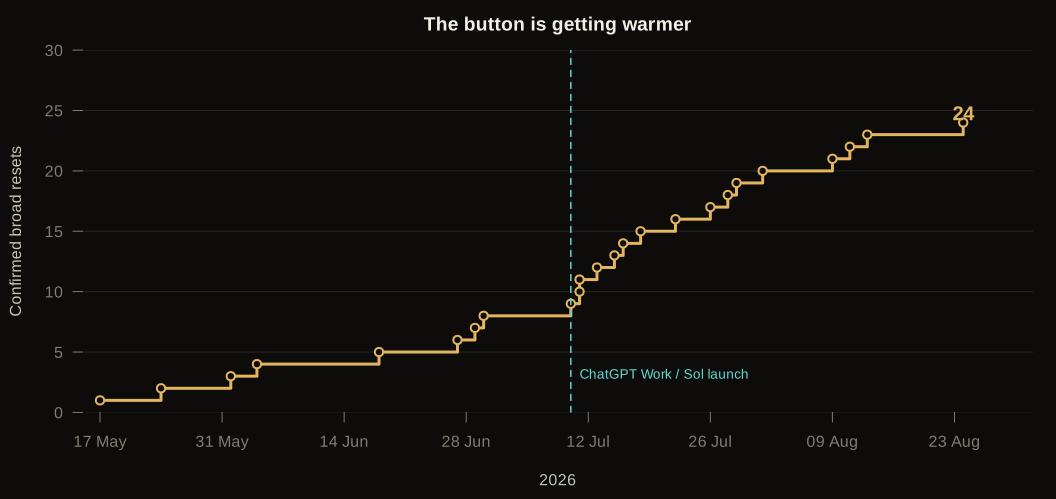
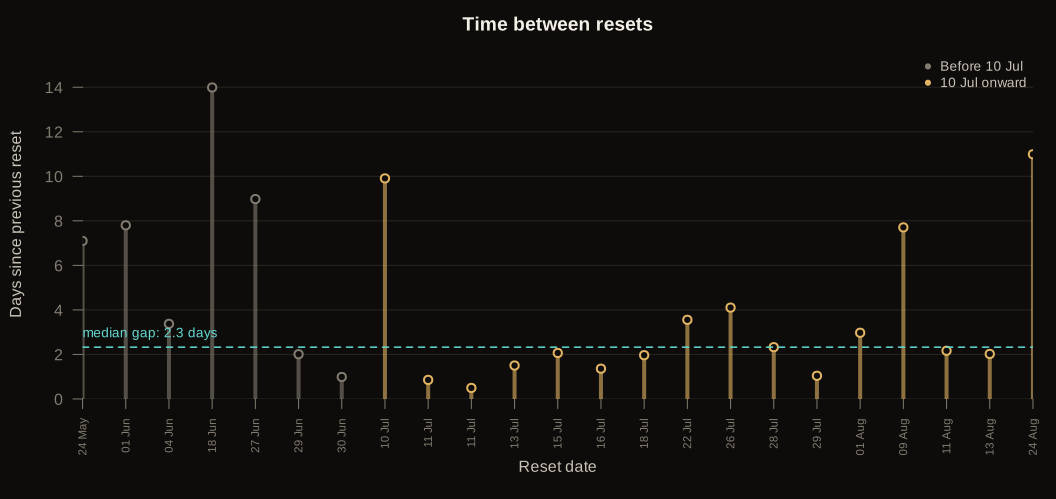
Twenty-four resets, every source.
Times are Australia/Sydney. A “press” means a public announcement of a broad immediate reset, not a joke, teaser, individual favor, or duplicate explanation.
All Codex accounts
A cache-hit regression during long-session compaction had drained limits faster.
Source tweet ↗All paid ChatGPT subscriptions
Five-million-user celebration; weekly and hourly limits returned to 100%.
Source tweet ↗Full Codex reset + banked reset
The “sneaky double reset,” after capacity errors were fixed.
Source tweet ↗All Codex users
Applied while the team investigated reports of unexpectedly fast usage drain.
Source tweet ↗Hard reset for everyone
Further usage-drain investigation; users kept their existing banked resets.
Source tweet ↗All Codex users + banked reset
Another full reset and one extra banked reset after the investigation.
Source tweet ↗Sol launch reset, part one
The first of two resets responding to launch excitement, confusing defaults and product regressions.
Source tweet ↗ChatGPT Work and Codex
Six-million-active-user milestone; the five-hour restriction was also temporarily removed.
Source tweet ↗All paid ChatGPT Work and Codex users
“Oops… I did it again.” A weekend reset amid rapid scaling.
Source tweet ↗All ChatGPT Work and Codex users
Compensation for an almost-global outage lasting roughly two hours.
Source tweet ↗All ChatGPT Work and Codex users
Paired with an update about GPT‑5.6 Sol consuming Codex limits faster than expected.
Source tweet ↗ChatGPT Work and Codex
A weekend reset celebrating efficiency improvements—and 100,000 Luna threads, naturally.
Source tweet ↗All paid ChatGPT Work and Codex users
Celebrating GPT‑5.6 Sol’s availability across harnesses—and Tibo not going anywhere.
Source tweet ↗All paid ChatGPT Work and Codex users
The promised Monday reset, confirmed with the admirably concise “Happy Monday.”
Source tweet ↗Codex accounts
Propagated alongside fixes for cache misses and long-session usage inefficiencies.
Source tweet ↗A small model with its homework showing.
The forecast is intentionally reproducible and appropriately unserious. Download the data, change the window, or replace the model entirely.
Event definition
A confirmed public announcement that broad Codex or ChatGPT Work usage was being reset. We excluded teasers, jokes, individual favors, future promises later confirmed elsewhere, and duplicate explanations.
Observation window
Sixteen events in the trailing 50 days ending 24 August at 1:20pm AEST. The fixed recent window reflects the post-launch operating regime without pretending May and July were identical.
Statistical model
A homogeneous Poisson event process with Jeffreys’ prior: λ ~ Gamma(½, 0). Given k events over T days, the posterior is Gamma(k+½, T).
What it gets wrong
Resets are not independent. They cluster around launches, incidents and milestones; Tibo can read this page; and the 50-day window is a judgment call. This is a cadence forecast, not leaked operational knowledge.
Data was collected from @thsottiaux’s public X timeline for 7 May–24 August 2026 and cross-checked using searches for “reset” and “usage limits.” Tweet timestamps were converted to Australia/Sydney. Announcements establish what Tibo publicly said, not exact backend propagation times. The 2.36× comparison uses the same event definition on both sides of 10 July, but unequal observation windows; it is descriptive, not causal.